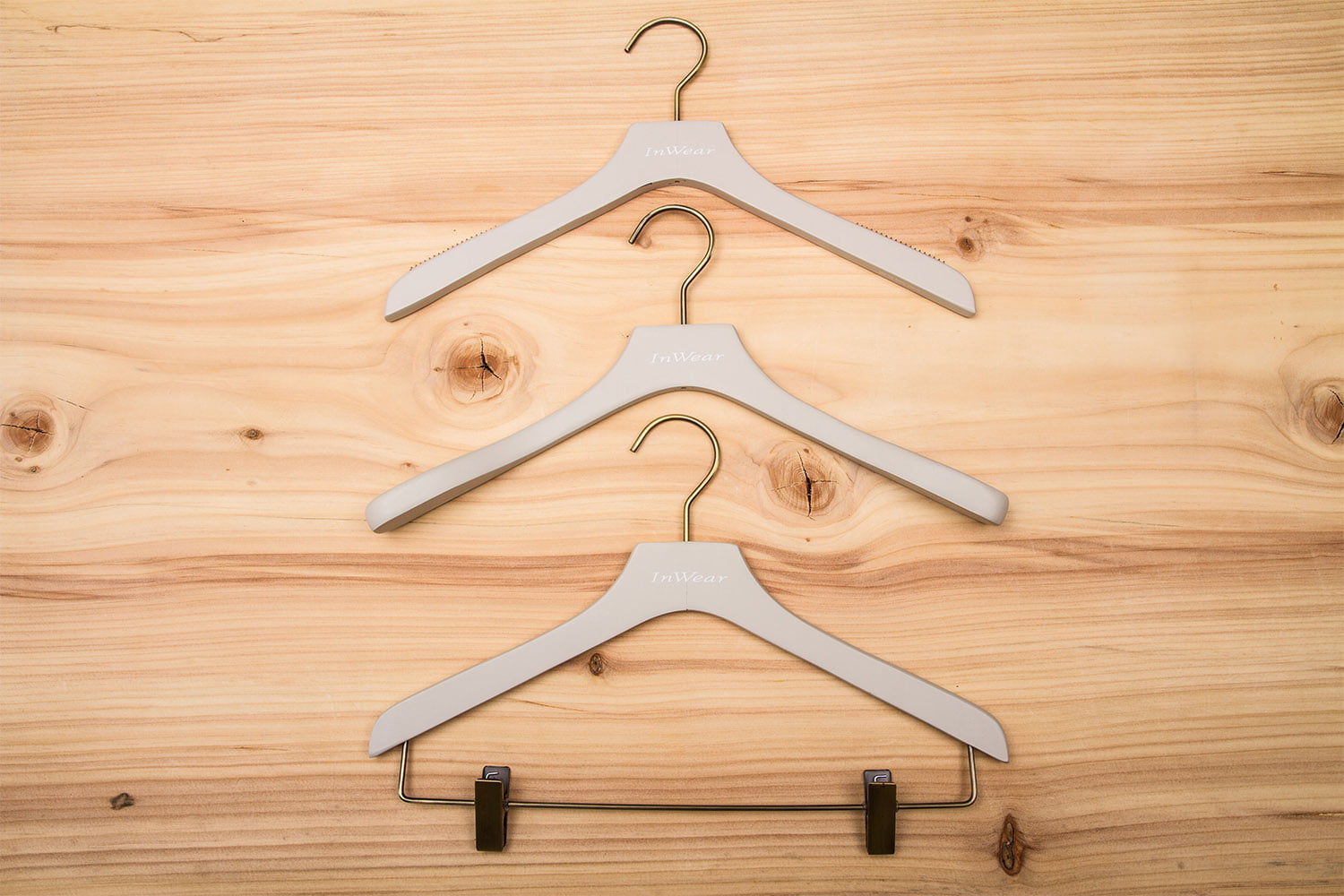
Why the hanger affects sales: presentation, touch and logo in the store

The customer sees the hanger before touching the garment and feels it before reading the price tag. Here is how material, uniformity and logo on the hanger affect perceived value, overview and recognition, and what you can do about it without changing the garments.
  • The hanger adds valueCustomers judge items by the context they are shown in. Garments on a solid wooden hanger are perceived as worth more than the same garments on a light plastic hanger.
  • A calmer railUniform hangers make the rack easier to take in, so the customer spends the time on the garments, not on decoding the clutter.
  • The logo customers touchA logo on the hanger is the touchpoint the customer handles most often in the store. From 300 pcs, models can be mixed.

Three things the hanger does to the customer's experience

Perceived value
Material, weight and surface affect how much the customer thinks an item is worth. A wooden hanger with a proper hook signals care and quality before the price is seen. That makes it easier to hold the price level.
Overview
The less visual noise, the faster the customer decides. Racks with one hanger type in one colour feel orderly, and the customer compares garments instead of hangers.
Recognition
The brand is remembered better the more often the customer sees and touches it. The hanger with a logo is the touchpoint handled most often in the store, and it often goes home with the customer.

Presentation decides the first impression

Most buying decisions in a clothing store are made quickly and without many words. The customer scans the rack, takes an item off, feels it and hangs it back. The hanger is part of that whole movement: it holds the shape, it sits in the hand, and it decides how calm the rack looks.

A hanger that does not carry the garment makes shoulders sag and jackets hang crooked. The collection then looks cheaper than it is, and staff spend time straightening it. A hanger with the right width and shoulder shows cut and proportions as the designer intended.

Touch: the hanger is the first thing the customer feels

The experience of quality is not only visual. When the customer takes the item off the rail, the hanger is the first thing the hand meets. Weight, surface and stability register before the garment is felt. Wood feels solid and warm, rubberised wood gives grip and a matt, calm surface, metal feels cool and precise. Plastic feels light and like something that belongs in the warehouse.

The choice between wood and rubberised wood is therefore not only about function. Classic wood signals craftsmanship and timelessness. Rubberised wood signals attention to detail, because it solves a practical problem with smooth fabrics in a way the customer can feel.

Uniformity gives calm and faster decisions

Customers make more confident choices in settings with low visual complexity. When the hangers are the same in shape, colour and material, the customer reads the range as one unified presentation. Mixed hangers from different suppliers and seasons pull the eye away from the garments.

The practical advice is simple: choose one hanger family and one colour as standard, use at most one variant to mark a department, and buy enough that the racks never have to be filled with whatever is in the stockroom. See the guide to colours and finishes.

Logo on the hanger: the touchpoint handled most often

Recognition is built by repetition. In a store, the hanger is the element the customer sees and touches most often: on the rack, in the fitting room, at the till and often at home in the wardrobe. A discreet logo on the hanger turns each of those touches into a meeting with the brand, without taking focus from the garments.

It also signals that the details have been considered. Stores and brands that take care with their fixtures are perceived as more trustworthy, and in boutiques and concept stores the logo hanger is an inexpensive way to get a unified look. On stock hangers the logo can be printed in 1–2 colours or laser-engraved from 300 pcs in total, and you can mix models. Try it in The Logo Designer, or see the prices under stock hangers with logo.

What you can do tomorrow

  • Count the hanger types on the floor. If there are more than two, there is a job to do.
  • Replace the thinnest first. Jackets and coats on hangers that do not carry them are the most visible problem.
  • Choose one colour and one family and buy enough for the whole store plus spares.
  • Consider a logo, when you are buying 300 or more anyway. The surcharge is from €1.00 per hanger.

How to get started

Time to unify the racks?
Woodnatural wood hangers, white, black and rubberised in stock. Delivery in 1–3 working days.
Want the logo on the hanger?
From 300 hangers in total, models can be mixed. We reply within 1 working day.
Used by 2,000+ stores and brands in Europe · Payment by card or invoice · Prices excl. VAT

Frequently asked questions

The hanger does not change the item, but it changes the context the item is judged in. Garments presented on solid, uniform hangers are perceived as worth more than the same garments on light, mixed hangers. That makes it easier to hold the price.

One family in one colour as standard, e.g. Bedford in white, plus the functions the garments require: shirt, coat and clip. At most one variant to mark a department.

A one-colour logo or a tone-on-tone laser engraving is discreet at a distance and is only seen when the customer has the hanger in hand. That is exactly where it works.

Wooden hangers from €1.15 per pc excl. VAT in packs of 50 or 100. A store with 1,000 hangers can switch to uniform wooden hangers from approx. €1,150 excl. VAT, logo from approx. €670 on top.

Read also

Buying guides
Choose the right hanger for your store
Shirt, coat, clip or trouser bar.
Materials
Wood, metal or plastic
Which hanger material suits your store.
Branding
Stock hangers with logo
Prices, minimums and delivery times.
Shopping cart
Your shopping basket is emptyBack to webshop
Calculate Shipping